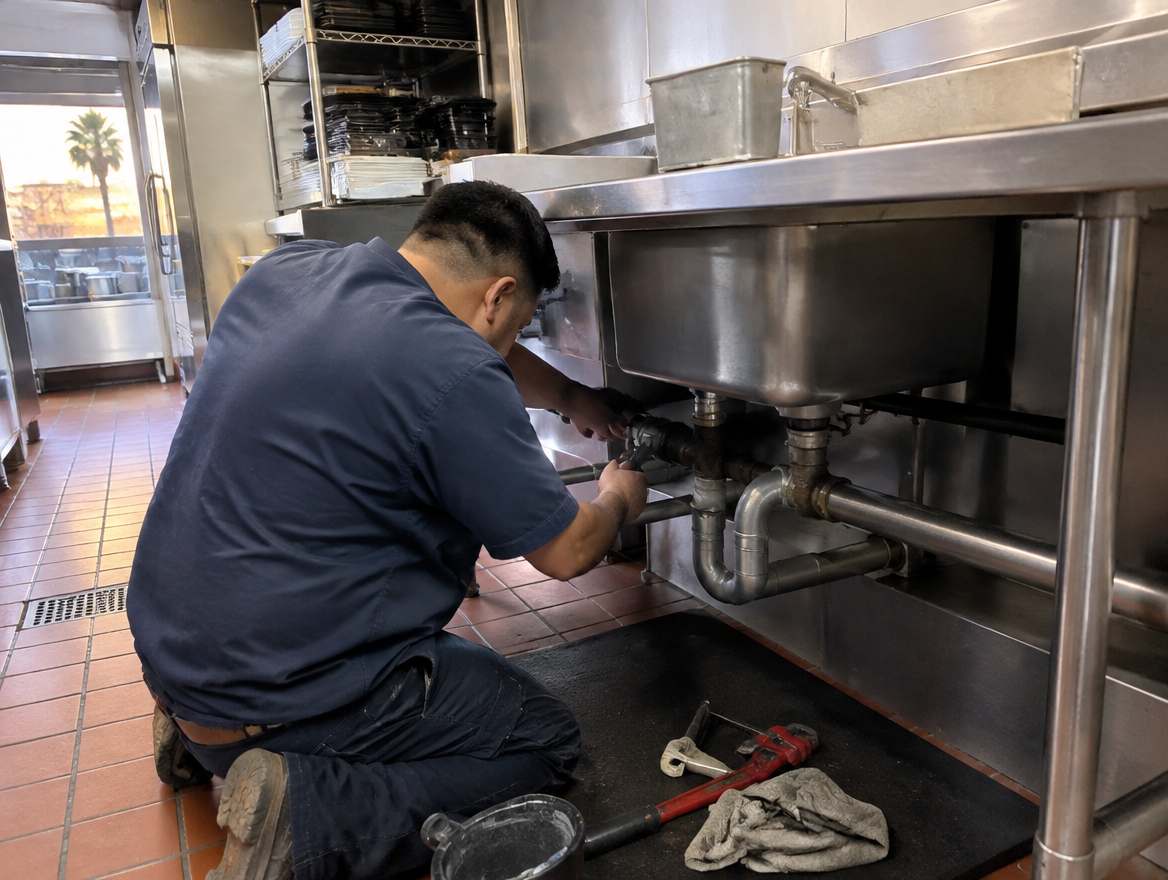
A busy kitchen's floor sinks start backing up when the dish machine drains. The usual cause is grease hardened in the line between the kitchen and the interceptor. Clearing it gets service back, but a camera look and a jetting schedule decide whether it comes back next month.
For Fullerton kitchens, storefronts and shared buildings
Restaurant and commercial plumbing in Fullerton, planned around your service
Floor sinks, grease interceptors, sewer laterals, hot water and kitchen gas lines. We find the cause before we quote, put the scope in writing and plan the work around your open hours.
Preview site for Fullerton Commercial Plumbing. The phone number is a temporary placeholder and the request form is not connected yet, so nothing you send reaches us.
- Gas smell. Everyone out. Call 911 or SoCalGas from the parking lot.
- Leak. Close the fixture stop, then the building main.
- Sewage. Stop draining into that line and keep food clear.
A floor sink that floods at 7:40 on a Friday is an operations problem first
You need to know three things before you need to know what broke. Can you keep serving? Which tenants share the line? Who has to sign off on the repair? We plan every commercial job around those answers, from a café near Cal State Fullerton to a full kitchen on Harbor Boulevard or an older storefront downtown.
Most calls trace back to six systems: kitchen drain lines carrying grease, the interceptor that catches it, the sewer lateral to the street, hot water for dishwashing and handwashing, gas to the cook line and the backflow assemblies that protect the city supply. The guides on this site cover each one, so you can describe the problem in a minute and judge any answer you get.
Most kitchen floods start weeks earlier as one slow floor sink. Log it when you see it, and we can fix it on a Tuesday morning instead of a Friday night.
Your kitchen warns you before it floods
Write down the day and the shift each sign shows up. A two-week log cuts diagnosis time on the first visit.
- Floor sinks or floor drains gurgle, drain slowly or push water back up when the dish machine or a three-compartment sink empties.
- A sour or sewer smell near the grease interceptor, mop sink or restroom floor drains, especially after closing.
- Grease or food solids showing up where they should not: in a clean-out, a restroom drain or the parking-lot manhole area.
- Hot water running out during the rush, or the water heater short-cycling, leaking at the base or tripping its relief valve.
- Several fixtures backing up at once, or a lower-floor tenant reporting backups when an upper unit runs water.
- Water stains, warped baseboards or damp drywall behind the line, under the bar or around walk-in coolers.
- A gas odor near ranges, fryers or the water heater. Treat this as an emergency, not a sign to monitor.
Fixture by fixture: how it fails and your first move
Tape this by the dish station. The two rows marked in rust are stop-everything situations. For the rest, you can protect the space and often keep part of the kitchen running while we get there.
| Fixture | How it usually fails | Your first move |
|---|---|---|
| Floor sinks and floor drains | Back up when the dish machine dumps; grease hardens in the line to the interceptor. | Stop draining equipment into that line and close off the wet floor. |
| Three-compartment and prep sinks | Slow drains from grease and food solids; leaks at the indirect drain or air gap. | Scrape and strain before washing; close the sink stops if a supply line leaks. |
| Grease trap or interceptor | An overfull unit pushes grease downstream or back into floor sinks; odor at the lid. | Check the last pumping date in your log and book service before you open. |
| Dish machine and booster | Misses wash or rinse temperature; hard water scales the elements. | Switch to an approved backup sanitizing method and write down the readings. |
| Water heater | Runs out at peak, leaks at the base, relief valve discharges, burner trouble. | Close the cold supply to the heater if it leaks; confirm it is strapped. |
| Gas to ranges and fryers | Odor at a connector or valve, or near the water heater. | Leave the building and call 911 or SoCalGas from outside. |
| Restrooms | Flush valves run on, urinals clog, dry floor drains let sewer gas in. | Close the fixture stop; pour water into dry floor drains to reseal the trap. |
| Main sewer lateral | Several fixtures back up at once; the lowest drains overflow first. | Stop all water use on that line and keep everyone away from sewage. |
The first ten minutes, before anyone arrives
Pin this next to the shutoff map. None of these steps needs anyone's permission.
Make your shutoff map- Right away
If anyone smells gas, get staff and customers out, do not switch equipment on or off, and call 911 or SoCalGas from outside the building.
- Next
Stop the water feeding the problem: shut the fixture stop, then the building main if the leak keeps going. Make sure every manager knows where the main is.
- Then
If sewage is backing up, stop running dishwashers and sinks that drain to that line, close off the area and keep staff and food away from the water.
- Before you call
Note what was running, which drains overflowed first and when the grease interceptor was last pumped. That record shortens the diagnosis.
- Shared building
For a shared building, tell the property manager and any tenants on the same line before calling a plumber, so nobody keeps running water into the backup.
- Before cleanup
Photograph the area and any damage for the owner, landlord or insurer before cleanup starts.
How we take a commercial job from first call to sign-off
A twelve-seat café and a strip center with eight suites get the same six steps. The schedule and the person who signs off are what change.
-
Intake and access
The plumber asks what failed, what is still usable, when the business opens and who can authorize work. Roof, clean-out and interceptor access is sorted out up front.
-
Find the cause
Clean-outs are opened, fixtures are tested one at a time, and a camera may go down the line to see grease build-up, roots, broken pipe or a belly before anything is quoted.
-
Written scope
You should get the findings and the proposed fix in writing: clearing versus repair, what equipment is used, whether permits apply and what the kitchen or tenants have to stop doing during the work.
-
Work around service
Many commercial jobs are planned before opening, after close or on a slow day. Hydro jetting, interceptor work and water heater swaps usually mean shutting part of the operation down.
-
Test and document
Lines are flushed and run under real load, gas connections are leak-checked, and backflow assemblies are tested by a certified tester. Keep the paperwork for inspections.
-
Prevent the repeat
Ask for a maintenance interval that fits your volume: interceptor pumping, scheduled line jetting and staff habits like scraping plates and keeping grease out of floor sinks.
Four calls Fullerton businesses make
A tenant converts an older retail space near downtown into a food business. The existing cast-iron or clay lateral may be decades old and was never sized for a commercial kitchen. A camera inspection before the build-out, and a conversation with the city about grease interceptor requirements, avoids surprises.
Several suites in a strip center share one sewer lateral. A backup shows up in the lowest suite even though the cause is upstream. The property manager, not one tenant, usually has to coordinate the work and decide who pays.
A café adds a second dishwasher or more handwashing stations and the tank water heater can no longer keep up at peak. The options are a larger tank, a tankless or multi-unit setup, or a booster for the dish machine. Each has gas, venting and seismic strapping requirements to check.
Guides, checklists and area notes
Written for the people who open and close the building: owners, kitchen managers and property managers.
- Field guides
Each guide covers one back-of-house or building system in plain language.
- Checklists
Printable sheets for the people who open and close the building.
- Worked examples
These are illustrative examples, not records of real jobs or customers.
- Service area
Notes on the commercial districts in and around Fullerton: what kinds of buildings are common, what tends to go wrong with their plumbing and which local agencies to check with.
What Fullerton's buildings and water do to your pipes
Fullerton's commercial buildings range from downtown storefronts built many decades ago to newer shopping centers, office parks and restaurants along Harbor Boulevard and the other major corridors. Older buildings often still drain through cast-iron or clay sewer laterals, which crack, settle and let tree roots in, and a kitchen's grease load makes any weak spot worse.
Water in the city comes from the City of Fullerton's own water utility, a blend of local groundwater and imported water, and it is hard. Scale builds up in water heaters, dish machine supply lines, ice machines and valves faster than in soft-water areas. Rules for grease interceptors, backflow testing and permits are set by the city and other agencies, so check with the city for current requirements rather than relying on a contractor's summary.
- Ask any contractor for the CSLB license number and look it up at cslb.ca.gov before work starts.
- Gas leaks and gas meter questions go to SoCalGas; leave the building first if you smell gas.
- Water heaters must be seismically strapped in California, including commercial units.
- Backflow testing schedules and approved testers: check with the City of Fullerton water utility.
- Grease interceptor sizing, pumping and records: check with the city before a build-out or change of use.
ZIP codes served: 92832 (Fullerton), 92835 (Fullerton), 92831 (Fullerton), 92833 (Fullerton).
Also nearby: 92801, 90621, 92805, 90631, 92870, 92806, 90638, 92821, 92802, 92804, 90603, 90604, 90620, 92865, 91748, 90623, 92840, 90680.
Questions owners ask us
We ask what kind of business you run, which fixture or line failed, whether you are open right now and who can approve work. We also ask about access to the roof, the clean-outs and the interceptor. In a shared building we want the property manager's name too.
Questions to ask any plumberWhy do restaurant drains keep clogging after they are cleared?
Snaking a line opens a hole through the grease but often leaves most of it on the pipe walls, so it closes up again. Hydro jetting cleans the full pipe diameter, and a camera inspection shows whether a sag, broken section or roots are catching grease. Staff habits and interceptor maintenance carry equal weight.
What is the difference between a grease trap and a grease interceptor?
People use the words loosely. A grease trap usually means a small unit under or near a sink. A grease interceptor is usually a larger in-ground tank serving the whole kitchen. Both separate fats, oils and grease from wastewater and both need regular cleaning. Check with the city for what your business is required to have.
How often should a grease interceptor be pumped?
It depends on the size of the unit, your menu and your volume, and local rules may set a maximum interval. Ask your pumper to record how full it is each time, and check with the city for any required schedule or reporting.
Does my business need backflow testing?
Many commercial properties have backflow prevention assemblies on fire lines, irrigation or the domestic water supply, and these generally need periodic testing by a certified tester. Check with the City of Fullerton water utility for your property's requirements and schedule.
Can plumbing work be done outside business hours?
Often, yes. Many commercial plumbers schedule jetting, interceptor service and water heater replacements before opening or after close. Ask about availability and how after-hours work is priced before you book.
Who pays when a shared sewer line backs up in a multi-tenant building?
That depends on the lease and where the blockage is. Lines inside one suite are often the tenant's responsibility, while shared laterals are often the owner's. Read the lease and involve the property manager early.
What should I do if I smell gas in the kitchen?
Get everyone out, do not operate switches, equipment or lighters, and call 911 or SoCalGas from outside. Do not go back in until you are told it is safe.
Send us the details
Your type of business, what failed, where in the building and since when. Urgent? Call (714) 555-0122.
Stop running water into it and keep staff and food away from any sewage. If anyone smells gas, get everyone out and call 911 or SoCalGas from outside. Whoever you hire, check their CSLB license at cslb.ca.gov first.
Before you hire anyone, us included
Ask for the CSLB license number and check it at cslb.ca.gov. Ask who will be on site, and confirm we serve your address before you book.
Fullerton Commercial Plumbing is the business name for this site. Licensing and service details will be published here once confirmed.