The warm hallway
A strip of tile in a 1970s single-story feels warm under bare feet and the water heater cycles more than usual. Closing the heater's cold inlet stops the meter, which points to a hot line under the slab.
Slab leak detection · Yorba Linda
A warm strip of tile. A meter that keeps turning with every tap off. We pinpoint the leak under your concrete first, then walk you through spot repair, reroute or repipe before anyone cuts a thing.
Preview site for Yorba Linda Slab Leak Repair. The number shown is a temporary placeholder and the request form is not connected yet, so a submission goes nowhere for now.
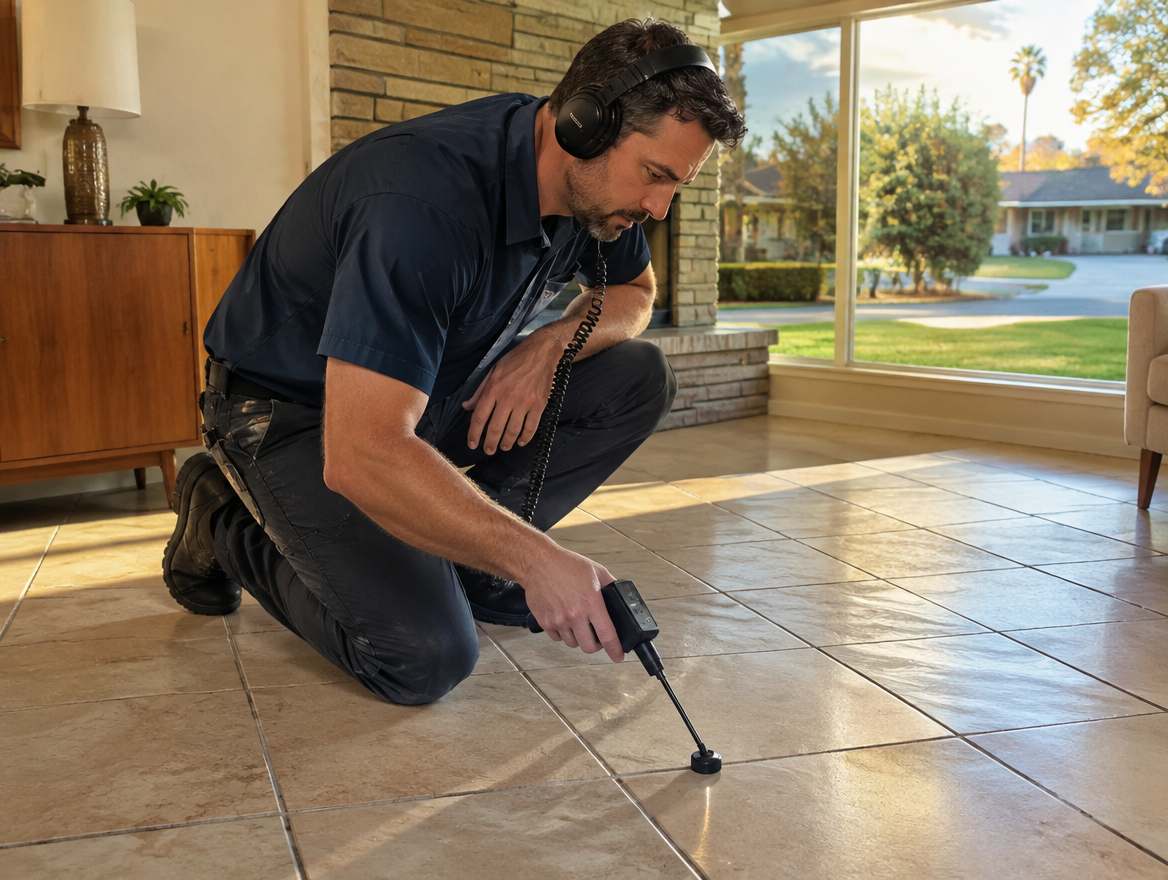
Acoustic gear listens for water escaping through concrete, so we open the floor in one spot, or not at all.
Try this first
Thirty minutes and a flashlight tell you whether water is escaping, and which side of the plumbing it is on. Bring the result when you call. It saves time on the visit.
Faucets, toilets, sprinklers, ice maker, softener. Wait for the toilets to finish refilling.
Open the meter box near the curb and watch the leak indicator for 15 to 30 minutes. Movement means water is escaping.
Shut the cold valve on top of the water heater. If the meter stops, the leak is on a hot line.
Under the concrete
Many Yorba Linda homes sit on a concrete slab poured over copper supply lines. When one of those lines wears a pinhole, the water soaks into the gravel below and the house above looks fine for weeks.
Hot lines fail most. They swell and shrink every time someone runs a shower, and that movement rubs the pipe against stone and concrete. Our local water is hard, a blend of groundwater and imported water, and its chemistry is one more thing we look at when copper wears thin.
A slab leak rarely means tearing up a room. We confirm the leak, trace the line and listen for the exact spot. Then you choose: open one small patch of floor, reroute the line overhead, or replace the old pipe for good.
Warning signs
One clue can have an ordinary cause. Two together, plus a meter that moves with everything off, call for a leak test.
Once it is located
The right fix depends on where the leak sits, how old the pipe is and whether it has leaked before. We put the options side by side so you can see the trade-off.
| Option | What we do | Fits when | Disruption | Ask us |
|---|---|---|---|---|
| Spot repair | We open a small patch of floor over the located leak, repair that section of pipe and patch the concrete. | The leak is pinpointed, the pipe around it looks sound, and it is the home's first slab leak. | One room. Expect concrete cutting and some flooring removal in that spot. | How did you locate it? Which flooring comes up, and does the quote include putting it back? |
| Reroute | We cap the leaking line and leave it under the slab, then run new pipe through the walls, ceiling or attic to the same fixtures. | The leak sits under flooring you want to keep, or the line is likely to fail again elsewhere. | Usually no concrete cutting. A few drywall openings along the new route. | Which fixtures does this line feed? Where do the openings go, and who patches them? |
| Repipe | We replace most or all of the home's supply lines with new pipe above the slab and retire the old under-slab runs. | The home has had more than one slab leak, or the original pipe is aging throughout. | The biggest scope: openings in several rooms and a longer, planned project. | Which pipe material, and why? How long is the water off each day? Does it need a permit? Check with the city. |
Before we arrive
The process
Confirm, locate, choose, repair, retest. We keep that order on every job, because cutting concrete before the leak is pinpointed wastes your floor and your money.
Call (714) 555-0139We read the meter with every fixture off and pressure-test the hot and cold sides on their own to learn which one is losing water.
We map the pipe's route under the slab, then use acoustic gear to hear water escaping through concrete. On hot lines, thermal imaging shows the warm path across the floor.
You get the choices in writing: a spot repair through the slab, a reroute through the walls or attic, or a repipe. We tell you which one fits your pipe age and leak history, and why.
A spot repair opens a small patch of floor, fixes the pipe and patches the concrete. A reroute caps the failed line in place and runs new pipe where you can reach it later.
We pressure-test the line and show you the meter standing still with every fixture off. That still dial is the proof.
Wet flooring, drywall and baseboards may need drying or replacing. We spell out which parts our plumbing scope covers and which belong to a flooring or drywall crew.
Guides, printable checklists, worked examples and neighborhood notes for Yorba Linda homes.
Short, plain explanations of how water escapes under a concrete slab, how we find the exact spot without guessing, and how to weigh a spot repair against a reroute or repipe.
Fill-in sheets for the meter test, your shutoff valves, insurance photos and the first visit.
Invented situations, not real jobs or customers.
Notes on the neighborhoods around Yorba Linda: the kinds of homes you find there, what that means for pipes under the slab, and who to call about water service and permits..
Examples
Illustrative situations, not real jobs or customers.
A strip of tile in a 1970s single-story feels warm under bare feet and the water heater cycles more than usual. Closing the heater's cold inlet stops the meter, which points to a hot line under the slab.
No puddles, no sounds, just a bill far above normal. The meter test shows slow, steady movement. Before blaming the slab, we check toilets, sprinkler valves and the yard line from the meter to the house.
A home that already had one slab repair now has a warm spot on a different line. This is where we talk about rerouting or repiping, since the original copper may be wearing out in more than one place.
Carpet along an interior wall is damp and the baseboard has swollen. It could be a slab leak, a line inside the wall, a shower pan or a drain. A still meter would point away from the supply lines.
Local notes
Yorba Linda runs from 1960s and 1970s single-story tracts to newer hillside and master-planned neighborhoods. Older homes often have their original copper under the slab. Newer homes vary by builder, so the right repair on one street can be wrong on the next.
Most Yorba Linda homes get water from the Yorba Linda Water District; your bill confirms your provider. If the leak looks like it sits at or before the meter, call the provider first. For permits or inspections, check with the City of Yorba Linda before work starts.
ZIP codes served: 92886 (Yorba Linda), 92887 (Yorba Linda).
Also nearby: 92807, 92808, 92823, 91709, 92870, 92867, 92861, 92821, 92865, 92869, 92806, 91765, 92831.
Questions
Start with the meter test. If the meter moves with everything off, rule out toilets, sprinklers and visible lines. A warm floor, running-water sounds or damp flooring on top of that make a slab leak likely. Pressure and acoustic testing confirm it.
A hot line expands and contracts each time someone runs hot water. Under a slab that movement grinds the pipe against concrete or gravel until it wears through. That is why a warm spot on the floor is the classic sign.
Not by default. A spot repair opens one small patch of slab. A reroute runs new pipe through the walls or attic and leaves the floor alone. A repipe replaces the old lines entirely. We explain which fits your house.
A reroute replaces one failed line, often a single hot or cold run, with new pipe above the slab. A repipe replaces most or all of the home's supply lines. A repipe is the bigger job and often makes sense after a second leak.
If the meter moves slowly and nothing is wet, many households close the water heater's cold inlet and use cold water only. If water is pooling or flooring is soaking, shut off the main until the leak is located.
That depends on your policy. Some policies treat access to the pipe, the pipe repair and the water damage differently. Call your insurer before work starts and keep photos, meter readings and invoices.
Water running under a slab for months can saturate or wash out the soil beneath it, which is one reason to stop a leak promptly. If you see new cracks or uneven floors, tell us and ask whether a structural evaluation makes sense.
Where in the house, since when, and what the meter test showed. Urgent? Call (714) 555-0139.
Run the meter test, close the water heater's cold inlet if the hot side is leaking, and shut the main if water is pooling. Then call us or send the details. Whoever you hire, check the license at cslb.ca.gov before any concrete is cut.
Call (714) 555-0139We ask what you noticed and when: warm spots, sounds, wet flooring, and whether you ran the meter test. If the meter stopped when you closed the water heater's inlet, tell us. That one detail narrows the search.
We explain how leak location works, what the visit covers and how repair options get quoted. You get the scope and price in writing before any concrete is cut or a reroute begins.