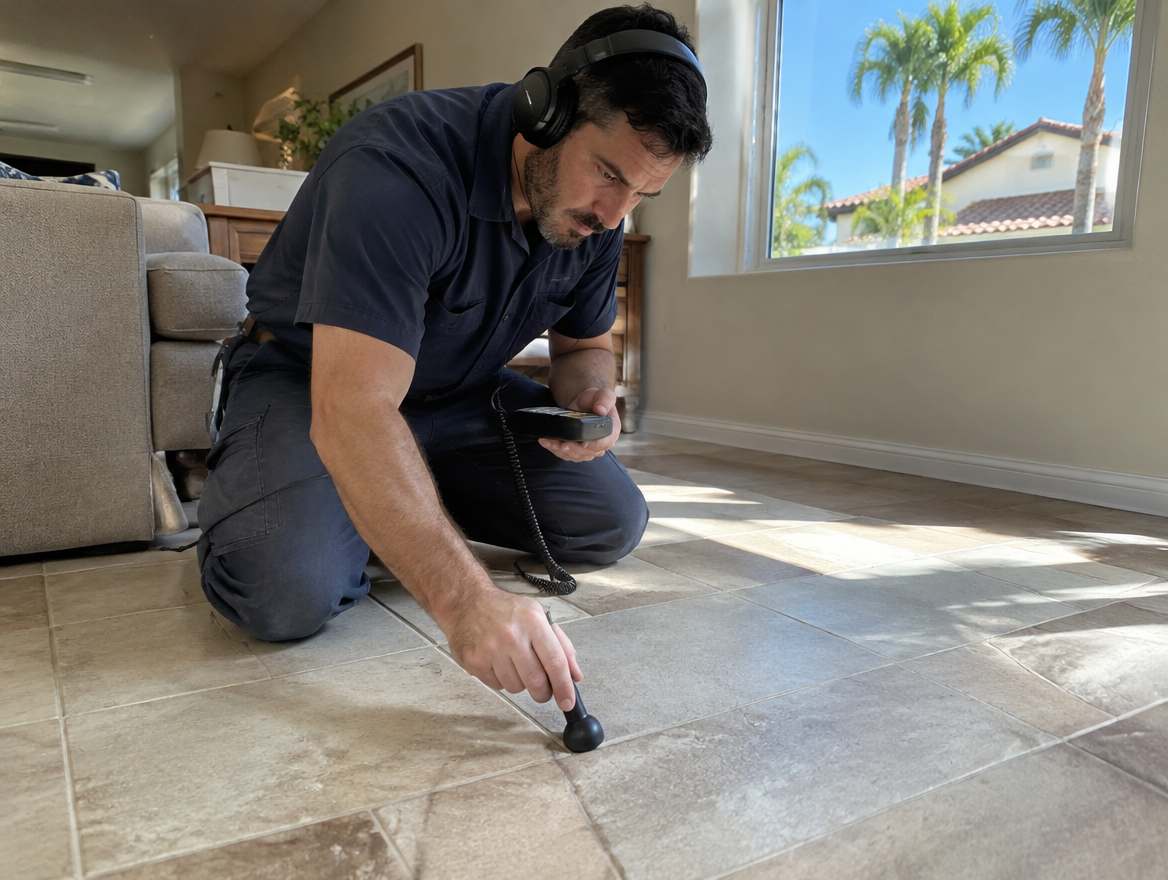
A warm kitchen floor in a 1960s tract home
A warm strip between the water heater and the kitchen usually means a hot line under the slab. Close the heater's cold inlet and watch the meter before anyone touches the concrete.
Hidden water leak detection · Fullerton, CA
Your bill doubled, the meter keeps turning, or the kitchen tile feels warm. We prove the leak at your meter, close valves until one line is left, then listen along it and mark a single spot. You repair a small opening instead of a hallway.
Preview site for Fullerton Leak Detection. Our phone number is a temporary placeholder and the request form is not connected yet, so nothing you send reaches us today.
Clues
One clue can be a coincidence. Two is a pattern.
Check your meterThe water bill jumped and nobody in the house changed a habit.
The small low-flow dial on your meter turns with every tap closed.
A warm stripe on the tile between the water heater and the kitchen.
A hiss inside a wall at 2 a.m., with the house silent.
Swollen baseboards, damp carpet at the edge, a closet that smells musty.
One strip of lawn stays green and soft through a dry week.
Do this first
Your water meter counts every drop that passes it, hidden or not. This test costs nothing, needs no tools and tells you whether to call anyone at all.
Turn off every faucet, the dishwasher, the washer, the ice maker and the sprinkler controller. Wait for toilets to finish refilling.
Lift the lid on the city meter box near the curb. Note the reading and the small low-flow dial.
Use no water for 20 minutes. Read it again.
If it moved, close the house shutoff and watch. Reopen it, close the cold inlet on the water heater, and watch once more.
| The dial | What it points to |
|---|---|
| Nothing moves | No measurable leak right now. Compare monthly usage and ask the city about your reading history. |
| Creeps slowly, mostly overnight | Usually a toilet flapper. Run the food coloring test in every tank first. |
| Keeps moving with the house shutoff closed | The leak is outside: the service line from the meter or a sprinkler line. |
| Stops when the heater's cold inlet is closed | A hot water line, often under the slab. Feel for a warm floor. |
| Spins fast, or you hear water running | Close the main now and keep it closed until the leak is located. |
This narrows the search. A licensed plumber confirms the location before anything gets opened.
Six inches of tile is a repair. Six feet of hallway is a remodel. Find the spot first.
Why here
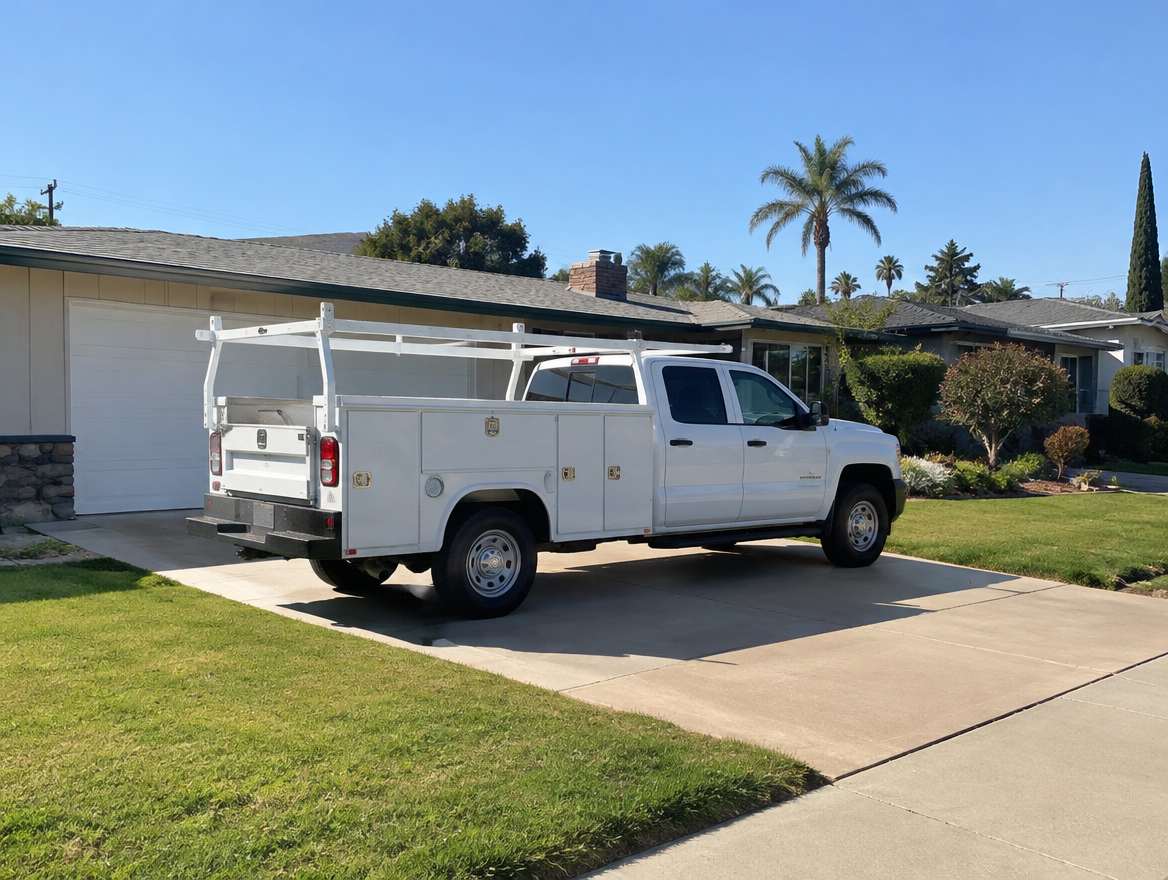
Much of Fullerton went up in the 1950s through the 1970s as single-story houses on concrete slabs, with copper water lines laid in the dirt underneath. A pinhole down there drains into soil and gravel. You notice the bill weeks before you see a drop.
Our water speeds it along. Fullerton blends local groundwater with imported supply, and the hard minerals wear on old copper and galvanized pipe. Hot lines usually fail first, since they expand, contract and run warm all day.
So we start at the meter and work inward. We prove water is leaving, close valves until one line stays guilty, then listen and scan along that line. The mark goes on your floor when the readings agree, and only then.
Right now
Six moves that protect the house and hand a plumber a head start.
Water on the floor? Close the main shutoff now. Most Fullerton houses have one where the line enters the house, and the city meter sits in a box near the curb.
Turn off every faucet, appliance and the sprinkler controller. Read the meter, wait 20 minutes without using water, then read it again.
Close the cold valve on top of the water heater. If the meter stops, the leak sits on a hot line.
Photograph the meter, the stains and any warm spots. Your phone stamps the time on each one.
Water near an outlet or light fixture? Switch that circuit off at the panel and keep everyone clear.
Call your insurer before anyone opens a wall, and ask what they want documented.
Process of elimination
Each step rules something out. By the end, one line and one spot are left. Ask us to explain each reading as we take it.
Send us the detailsWith every fixture off, we watch the low-flow dial. If it turns, water is leaving somewhere past the meter.
We close the house shutoff. A meter that keeps moving points to the service line or irrigation in the yard.
Gauges and valves test the hot side, the cold side and each branch, so the search shrinks to one pipe.
Acoustic gear picks up water escaping under concrete. Thermal imaging and moisture readings trace hot lines and damp drywall.
We mark the spot and walk you through a spot repair, a reroute through the walls or attic, or a repipe, with the reasons for each.
After the repair we pressure test the line and read the meter again with everything off.
Patterns
A warm strip between the water heater and the kitchen usually means a hot line under the slab. Close the heater's cold inlet and watch the meter before anyone touches the concrete.
If the meter keeps moving with the house shutoff closed, the leak is outside: the service line or the sprinklers. Walk the yard for a soft, extra-green strip.
Supply line, drain, toilet seal or shower pan. Run one fixture at a time while someone watches the ceiling, and the culprit usually shows itself.
A toilet flapper leaking into the bowl looks like a hidden leak on the meter. Drop food coloring in the tank and check the bowl in 15 minutes.
Field guides, printable worksheets, worked case files and notes on Fullerton neighborhoods.
Where Fullerton leaks start, how to prove one from your own meter, and how we trace it to a single spot before any concrete or drywall gets cut..
Meter logs, shutoff maps, symptom diaries and hiring checklists.
Invented examples, not real customers or jobs.
House ages, pipe materials, slab or raised floors, and who runs the water in each part of town.
Local notes
Fullerton runs its own water utility, so your meter and bill come from the city. If usage jumps, call the city's water billing office for your reading history and ask whether a leak adjustment exists. Rules change, so check with the city; we won't quote them here.
Older blocks in Fullerton and next door in Anaheim, Placentia, Buena Park, La Habra, Brea and Yorba Linda share a pattern: slab floors, copper or galvanized supply lines and hard water. Newer homes leak too, but slab leaks cluster in the postwar houses.
The city meter usually sits in a box near the street or sidewalk. Keep the lid clear so you can read it.
Hard water scale and pinhole corrosion start most copper leaks.
A plumbing contractor should hold an active C-36 license. Check any license at cslb.ca.gov.
Ask any company, us included, to confirm your Fullerton address is in its service area.
Repiping and rerouting go through city permits; check with the city for what your job needs.
ZIP codes served: 92832 (Fullerton), 92835 (Fullerton), 92831 (Fullerton), 92833 (Fullerton).
Also nearby: 92801, 90621, 92805, 90631, 92870, 92806, 90638, 92821, 92802, 92804, 90603, 90604, 90620, 92865, 91748, 90623, 92840, 90680.
Questions
Turn off every fixture, appliance and the sprinklers, then watch the water meter. If the dial or low-flow indicator moves, water is leaving the system. A rising bill, a warm floor or the sound of running water back it up.
Not to find it. Pressure testing, acoustic listening and thermal imaging locate the leak from above. The repair may need a small opening in the concrete, or the line can be rerouted overhead instead.
A warm patch often means a hot water line is leaking under the slab. Close the cold inlet valve on the water heater and watch the meter. If it stops, the leak is on the hot side.
Yes, and it's the cheapest thing to rule out. Put food coloring in each toilet tank and wait 15 minutes without flushing. Color in the bowl means the flapper leaks.
Owners generally handle the line on their side of the meter, but ask the City of Fullerton water utility to confirm for your address.
It depends on the pipe and its history. One leak in sound pipe usually gets a spot repair. Repeat leaks in old copper or galvanized pipe make a reroute or repipe worth pricing. Ask for the reasoning in writing.
Policies differ, and many treat the pipe repair and the water damage separately. Call your insurer, document everything and ask what they need before work starts.
Send the details
Run the meter test, write the numbers down and close the main if water is spreading. Then send us the details. Whoever you hire, us included, check the CSLB license at cslb.ca.gov first. Preview note: the form is not connected yet.
We'll ask for your meter readings, when the bill changed, the age of the house, slab or raised floor, and where the water heater sits. Have the photos handy and the call stays short.
Ask us how we locate leaks, what the detection visit covers, whether it's quoted apart from the repair, and who does the work. Get every price in writing first. And a plain note: this is a preview site. The phone number is a temporary placeholder and the form isn't connected yet, so a submission goes nowhere today.
Your readings, where you see or hear signs, and when the bill changed. Urgent? Call (714) 555-0110.