Burst and broken pipes in Fullerton

Burst pipe in Fullerton? Close the main, then call us.

Each minute the water runs, it soaks further into drywall, carpet pad and slab. Stop it at the main shutoff. Then our plumbers find the exact break and fix it, opening as little wall or floor as the repair needs.

Preview site for Fullerton Burst Pipe Repair. The phone number shown is a temporary placeholder, and the request form is not connected yet, so submissions are not sent anywhere.

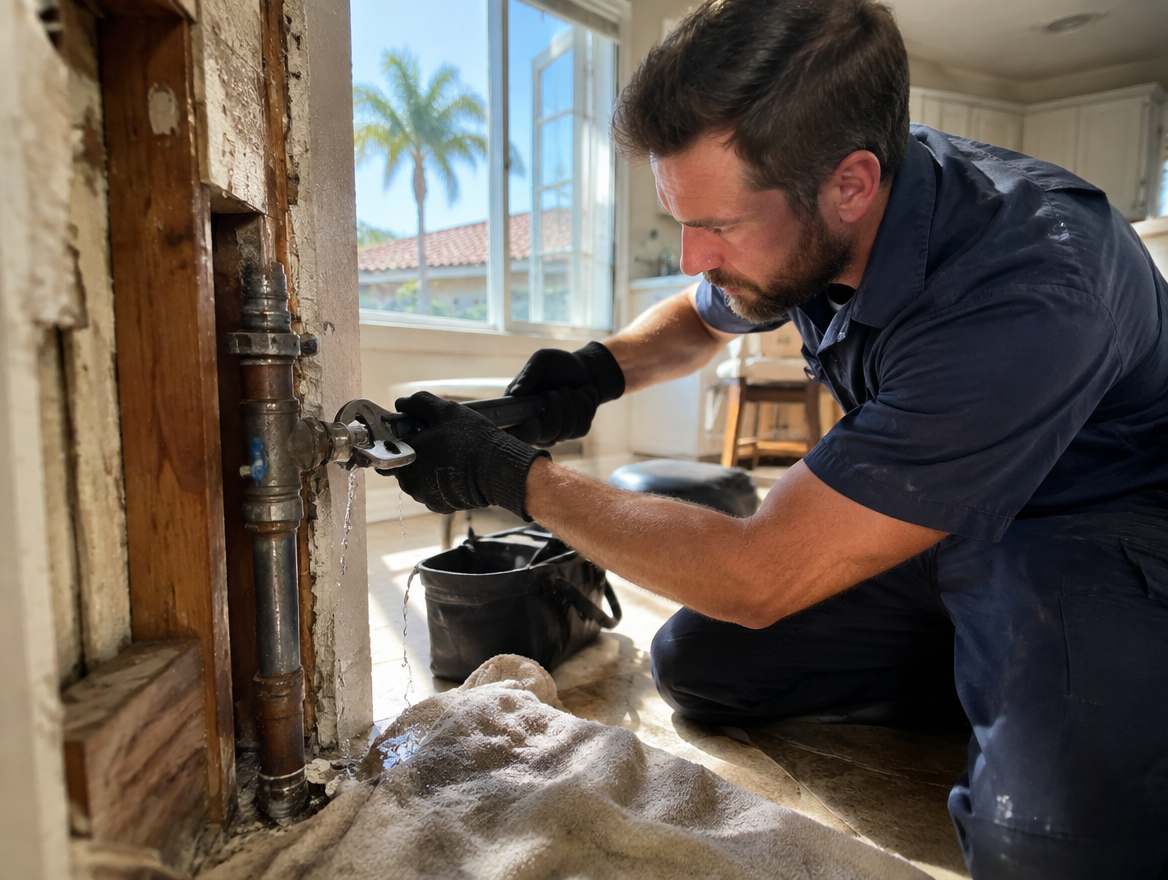
A plumber shutting off the water main during a plumbing emergency

Stop the water first. Then we find the exact break and open only the wall the repair needs.

Why it happened

Fullerton pipes break from age, not frost

Hard freezes are rare here. Time is what breaks pipes in Fullerton. Much of the city went up in the 1950s through the 70s as tract homes on concrete slabs, plumbed with galvanized steel or copper that has carried hard water for fifty years or more. Galvanized rusts from the inside until the wall thins and splits. Copper grows pinholes that start as a drip and open under pressure.

Parts fail too. Rubber washer hoses, braided supply lines under sinks and toilets, and water heater connectors wear out and let go without warning. High street pressure, or a regulator that has stopped doing its job, pushes on each of those weak points.

The fix starts the same way every time. You stop the water at the main, keep people clear of wet outlets and photograph the damage. Then a plumber finds the exact break before anyone picks between a spot repair, a reroute or a repipe.

Find the valve

Where is the water coming from?

Find the spot, close the valve nearest the break, and the rest of the house can often keep running. When in doubt, close the main.

  • Under a sink

    Shut off now
    Usual culprit
    A braided or plastic supply line, or a corroded fitting
    Close this first
    The two small angle stops under the sink, turned clockwise. If they won't move, the main.
  • Behind a toilet

    Shut off now
    Usual culprit
    The supply line, or its connection at the fill valve
    Close this first
    The angle stop on the wall behind the toilet. Then flush to empty the tank.
  • Washing machine

    Shut off now
    Usual culprit
    A rubber fill hose split or burst at the crimp
    Close this first
    The hot and cold hose valves behind the machine, or the main.
  • Water heater

    Shut off now
    Usual culprit
    A flex connector, a fitting or a failing tank
    Close this first
    The cold inlet valve on top of the heater. Turn the gas control to off or pilot, or switch off its breaker.
  • Inside a wall or ceiling

    Shut off now
    Usual culprit
    A copper pinhole or a rusted-through galvanized section
    Close this first
    The main water shutoff.
  • Under the slab

    Shut off, then locate
    Usual culprit
    A hot or cold line under the concrete foundation
    Close this first
    The main. If the leak is on the hot side, also the water heater's cold inlet.
  • In the yard, meter to house

    Shut off now
    Usual culprit
    The service line between the meter and the house
    Close this first
    The main at the house. If that doesn't stop it, the curb valve in the meter box.
  • At or before the meter

    Call the city
    Usual culprit
    Utility-side pipe or the meter connection
    Close this first
    Nothing on your side. Call the City of Fullerton water utility, since that side is usually theirs.

In the first ten minutes

Six things to do, in this order

The first one stops the damage. The rest keep people safe and make the repair and any insurance claim easier.

  1. Close the main water shutoff. On many Fullerton tract homes it sits where the line comes out of the ground, near the front hose bib or in the garage. If you can't find it or it won't turn, the curb valve in the meter box can stop the flow, though it may need a meter key.
  2. Keep people and pets away from standing water near outlets, power strips and appliances. If water is reaching a panel or wiring, switch off that circuit only from a dry spot. Otherwise stay out and call 911.
  3. If the break is on the hot side or at the water heater, turn the heater's gas control to off or pilot, or switch off its breaker, and close its cold inlet valve. If you smell gas at any point, leave the building and call 911 or SoCalGas from outside.
  4. Open a faucet at the lowest point of the house to drain the lines. Then lift furniture, rugs and boxes out of the water and start drying.
  5. Photograph the break, the path the water took and anything damaged before cleanup. Keep the failed part, such as a burst hose or connector.
  6. Call a plumber, us included, and look up their CSLB license at cslb.ca.gov before work starts. If the leak is at or before your water meter, call the City of Fullerton water utility. That side is usually theirs.
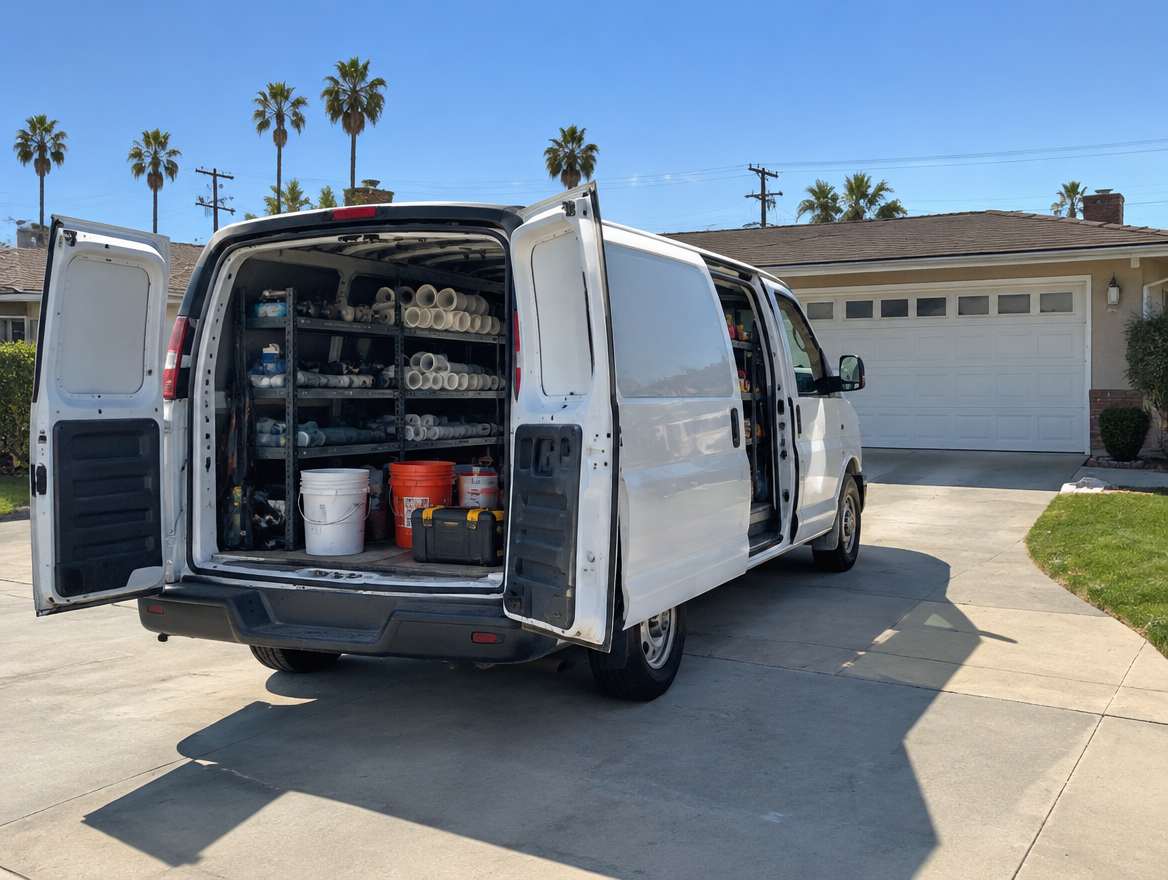
An unmarked plumbing service van parked at a home in Fullerton, California

Illustration for this preview site, not a photo of our own work.

Hidden breaks

How a hidden break gives itself away

Some breaks spray across the kitchen. Others leak inside a wall or under the slab for days before anyone notices.

  • Water pooling or running where it shouldn't, with every fixture off
  • A hiss or rush inside a wall, ceiling or floor when nothing is running
  • The leak indicator on your water meter keeps turning with all taps and appliances off
  • A warm or damp patch on a slab floor, or flooring that lifts, buckles or smells musty
  • Pressure drops at several fixtures at the same moment
  • Rust-colored water, bulging drywall, or a ceiling stain that keeps growing
  • A water bill well above the same months last year

The repair

How we find and fix the break

The work runs in a set order. Knowing it lets you judge whether any plan put in front of you makes sense.

  1. Make the house safe

    We confirm the main is holding, the water heater is off or safe, and nothing electrical is wet before we open anything.

  2. Find the break

    A visible break is easy. A hidden one gets a pressure test on isolated sections and, when needed, acoustic or thermal leak detection, so we open walls and slabs only where the leak is.

  3. Lay out the options in writing

    Depending on the pipe, that means a spot repair, a reroute through the attic or walls around a slab leak, or a section or whole-house repipe when the old line is failing throughout. Get the plan and the price in writing before work begins.

  4. Make the repair

    We cut out the damaged pipe and replace it with matching or approved material. Where copper meets galvanized, a dielectric fitting keeps the joint from corroding.

  5. Test the whole line

    The repaired section goes under pressure, each fixture runs, and we check the house pressure. A reading well above normal points to a failing regulator, which can cause the next break.

  6. Close up and hand off

    We close the access holes or leave them ready for a drywall or flooring trade. You get notes on what failed, what we replaced, and whether the work needed a city permit.

Illustrative examples

Four breaks common in Fullerton homes

A washer hose bursts in the garage

A rubber fill hose splits while nobody is home. Close the machine's two supply valves or the main, push the water out the garage door, and replace both hoses. The plumbing fix is small. The bigger question is how far the water travelled under the walls.

Galvanized pipe splits inside a wall

A home still on galvanized gets a sudden spray behind the kitchen sink. We can patch the broken section, but when one spot rusts through, others tend to follow, so price a section or whole-house repipe at the same visit.

A warm patch on the slab floor

The tile feels warm and the meter moves with everything off. That pattern points to a hot-water line leaking under the slab. Leak detection pinpoints it, and then you choose between opening the floor for a spot repair or rerouting the line overhead.

The yard line breaks between meter and house

Water bubbles up in the lawn or along the driveway. The line from the meter to the house is usually yours to repair. A break at or before the meter is usually the city's. We can confirm which side it's on.

Fullerton

Fullerton's houses, and why their pipes fail

Fullerton runs from older streets near downtown and the university to the postwar and 1960s and 70s tracts that cover much of the city. A large share of those homes sit on slabs, with water lines now fifty years old or more. Galvanized corrosion, copper pinholes and slab leaks come up again and again.

The water here is hard, a blend of local groundwater and imported water, and its minerals scale up inside pipes, valves and water heaters. The City of Fullerton runs its own water utility. For meter questions, breaks on the street side or help with the valve at the meter, check with the city.

  • Find and test your main shutoff today. A valve nobody has turned in years can stick or leak at the stem.
  • Galvanized lines in older homes fail in more than one place, so ask about the whole line after any break.
  • A slab house can hide a leak under the floor. A meter that moves with every tap off is the fastest check you can do yourself.
  • Hard-water scale wears out valves, hoses and heater connections sooner. Replace aging supply hoses before they burst.
  • Ask any plumber, us included, to confirm your Fullerton address is in their service area and to give you their CSLB license number.
Map shows the area served, not an office location. Open in Google Maps

ZIP codes served: 92832 (Fullerton), 92835 (Fullerton), 92831 (Fullerton), 92833 (Fullerton).

Also nearby: 92801, 90621, 92805, 90631, 92870, 92806, 90638, 92821, 92802, 92804, 90603, 90604, 90620, 92865, 91748, 90623, 92840, 90680.

Questions

What Fullerton homeowners ask about burst pipes

Where is the main water shutoff on a Fullerton house?

On many slab-built tract homes it is a valve where the supply line comes out of the ground and enters the house, often near the front hose bib or in the garage. There is also a curb valve inside the meter box near the street, which may need a meter key. Find yours now, before you need it.

Can I keep using water after I close the main?

No. With the main closed, the house has no supply. Toilets have only what is left in the tank. Once the break is isolated, a plumber can sometimes cap the broken branch so the main can be reopened for the rest of the house.

Do pipes freeze and burst in Fullerton?

It is uncommon. Most burst pipes here come from corrosion, worn supply hoses and connectors, high water pressure, or slab leaks rather than freezing. Exposed lines in very cold snaps can still be insulated as a precaution.

Is a slab leak the same as a burst pipe?

A slab leak is a break in a line running under the concrete foundation. It often starts small and can go unnoticed for days. The fix is either opening the slab at the leak or rerouting that line through the walls or attic.

Should I repair the broken section or repipe the house?

A single failure in otherwise sound pipe is often a spot repair. If the line is old galvanized, or copper has had several pinhole leaks, a section or whole-house repipe may make more sense. Ask the plumber to show you the condition of the pipe they cut out.

Who fixes a break between the water meter and the street?

Leaks at or before the meter are usually the city water utility's responsibility. The line from the meter to your house is typically yours. Check with the City of Fullerton if you are unsure which side a leak is on.

Will a burst pipe affect my water heater?

It can. If the hot side is broken or the main is off for a long time, turn the heater's gas control to off or pilot, or shut off its breaker, until water is restored. Water heaters in California must be seismically strapped, so check the straps if the heater was disturbed.

Before you hire anyone

Six questions to ask any plumber, us included

How do I check a plumber's license?

Ask for the contractor's CSLB license number and look it up at cslb.ca.gov. The lookup shows whether the license is active and what classification it covers.

How do I know the plumber found the real break?

Ask how they located it and whether the line held pressure after the repair. A good repair ends with a pressure test and the meter's leak indicator standing still.

Will they have to open my wall or floor?

Often, yes, but only as much as needed. Leak detection narrows the spot first. Ask where they plan to cut and who handles patching drywall or flooring afterward.

Will I get the price before work starts?

You should. Ask for a written estimate covering the repair, any access holes and testing, and ask what would change the price once the pipe is exposed.

Does the repair need a permit?

Some plumbing work, such as repiping or water heater replacement, typically needs a permit. Ask the plumber, and check with the City of Fullerton's building department if you are unsure.

What should I keep for my insurance claim?

Keep photos taken before cleanup, the failed part, drying receipts, and the plumber's written description of the cause and repair. Ask your insurer what else they need.

Fullerton Burst Pipe Repair is the business name for this site. Licensing and service details will be published here once confirmed.

More questions to ask before hiring a plumber

Tell us about the broken pipe

Where the water is coming from, what the pipe looks like, and whether the main is off. Urgent? Call (714) 555-0111.

By sending this form you agree to the privacy policy.

Pipe just burst?

Close the main water shutoff. Keep everyone away from wet outlets and wiring. Photograph the damage, then call us or send the details, and check any plumber's CSLB license at cslb.ca.gov before work starts. If you smell gas, leave and call 911 or SoCalGas from outside.

Call (714) 555-0111

What we'll ask when you reach us

Is the water off? Where is the break? What does the pipe look like: copper, galvanized, plastic or a flexible connector? How long did it run, and did water reach ceilings, floors or wiring? Photos on your phone speed this up.

Whoever does the work should tell you how they'll find the break, put the options and the price in writing before work begins, and say whether the job needs a city permit. If any part of the plan is unclear, ask before anyone opens a wall or floor.

This is a preview site: the phone number shown is a temporary placeholder and the request form is not connected yet, so a submission is not sent anywhere for now.

Call Get help